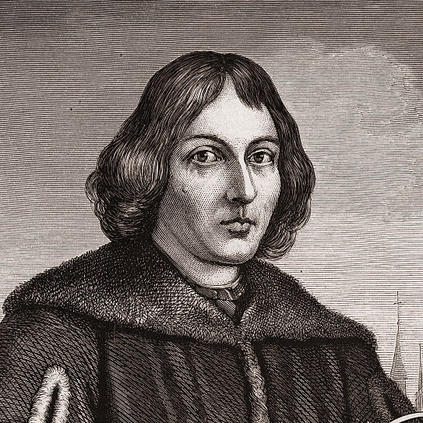
Nicolaus Copernicus


BACKGROUND INFO

Early Life

Born in Torun, Poland on February 19, 1473Born into a wealthy family and was the youngest of 4 childrenHis Nobleman uncle became his guardian after his father died when Copernicus was 10 years old

His Inspirations

Ptolemy; Copernicus was able to prove Ptolemy's theory wrongDomenico Maria Novara; Copernicus's professor at the University of KrakowCopernicus was an apprentice of NovaraElements of Geometry by EuclidIn Judgement of the Stars by Haly AbenragelAstronomical and Mathematical Tables by Johannes RegiomontanusAstronomical Tables by Alfonso X of Castile

People He Worked With

Domenico Maria Novara did astronomy work with himAndreas Osiander oversaw the printing of Copernicus's bookGeorg Joachim Rheticus
Studied with CopernicusHelped publish his bookBrought mathematical books to help Copernicus finalize calculationsLucas Watzenrode was his uncle; Copernicus acted as his secretary and physician

Academic Life

Devoted his life to science, the Church, and government, so he did not marry or have childrenStudied astronomy, math, philosophy, and the sciences at the University of Krakow (enrolled in 1491)His uncle sent him to Bologna, Italy to study Canon law, becoming a Canon of the Catholic Church in WarmiaAt first, did not publish his work, because it contradicted the Church's doctrinesShared his work among his close friends and other philosophersHis book, On the Revolution of Celestial Spheres, was dedicated to the PopeHis book was published shortly before his death in 1543Died on May 24, 1543 at the age of 70 years old due to a stroke

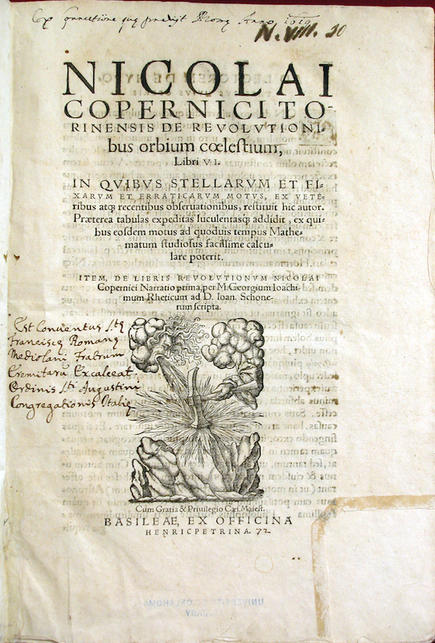
Copernicus's Book, _On the Revolution of the Celestial Spheres_

The front page of Copernicus's book, On the Revolution of the Celestial Spheres

ROLE IN THE SCIENTIFIC REVOLUTION

Role in the Scientific Revolution

Reached conclusion of the heliocentric model, which reached a wider audienceSparked Scientific Revolution for astronomy after his deathModeled the correct ordering of plants in the solar system

How He Introduced His Thoughts

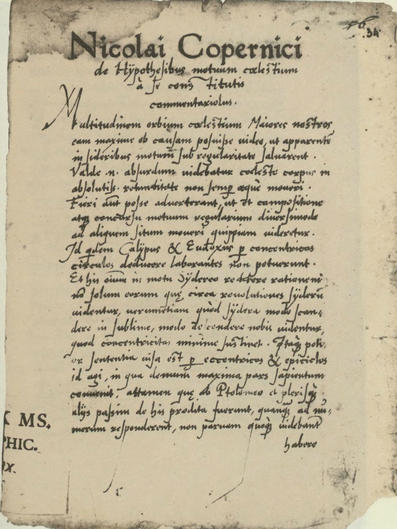
Gave friends the Commentariolus (1514), a handwritten manuscript of his views of the universeCopernicus also sent copies of his manuscript to other astronomers and philosophersHis thoughts were introduced to a wider audience with the 6 books within On the Revolutions of the Celestial Spheres (published 1543)

Struggles He Faced

Creating the model of planets and the Sun was mathematically challengingFeared the Church, so he did not publish his findings until the year of his deathThe publisher of Copernicus's On the Revolutions of the Celestial Spheres wrote a note without permission, saying that his his theory was untrue and unusual

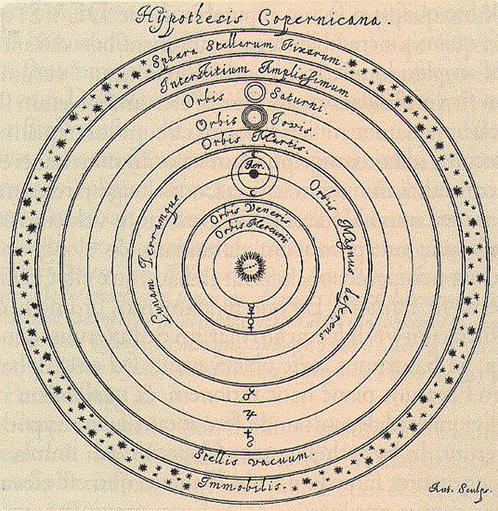
Copernicus's Model of the Solar System

His Discoveries and Things He Introduced

Introduced the heliocentric system, stating planets revolve around the sunThe Copernican System
A theory that the sun is the center of the solar system, and all the plants orbit around itFound in his book, and contained mathematical and astronomical data serving as the basis of the Copernican SystemCauses of Earth's Rotation
The rising and setting of the sunthe movement of the starsThe cycle of seasons happens because of the earth's revolution around the sunAssumptions in the Commentariolus
Earth is the center of the moon's orbitThe universe is bigger than it is thought to beThe distance from the earth to sun is a fraction of the size of the universe

Copernicus's Commentariolus

Scientists He Inspired

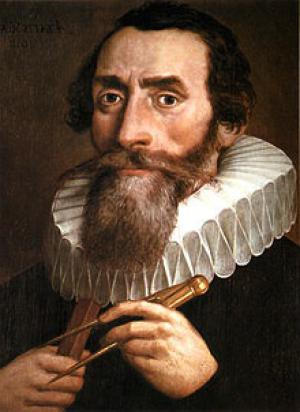
Johannes Kepler (1571-1630)
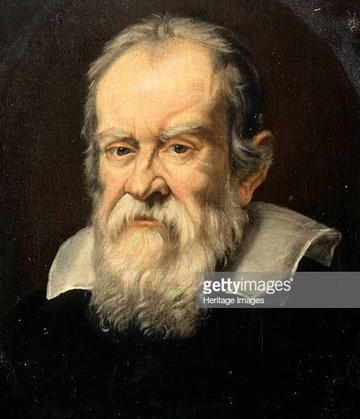
An assistant of Brahe who supported heliocentric beliefsPublished books that supported Copernicus and the heliocentric theoryGalileo Galilei (1564-1642)
Discovered various things with the telescope, such as:The phases of VenusThe 4 moons of JupiterThe Sun was the center of the universeGeorg Joachim Rheticus (1514-1574)
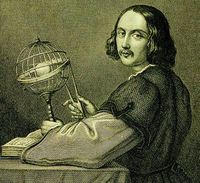
Worked alongside Copernicus as a pupil, helping him with the mathematics on planetary movementWrote The First Report, which summarized Copernicus's works before they were published

Johannes Kepler

Galileo Galilei

Georg Joachim Rheticus

INTERESTING FACTS

Went to four universities in Poland and Italy, but did not get any degrees since it was not neededWas a physician at the University of Padua, but never got his degreeThe element "Copernicium" is named after him

PRIMARY SOURCE

Source

“I CAN easily conceive, most Holy Father, that as soon as some people learn that in this book which I have written concerning the revolutions of the heavenly bodies, I ascribe certain motions to the Earth, they will cry out at once that I and my theory should be rejected.” - Nicolaus Copernicus in On the Revolutions of the Heavenly Bodies [Celestial Spheres]

Analysis

Copernicus's ideas were not widely accepted until the 17th centuryThe Church was strongly against his theories, banning Copernicus and his followers' booksScientists like Copernicus gained traction from the Church, but proved science was based on observations and evidenceCopernicus was able to spark the Scientific Revolution, because he was assertive about the heliocentric model, unlike Nick Oresme

Source

"I have found by many and long observations that if the movements of the other planets are assumed for the circular motion of the Earth and are substituted for the revolution of each star, not only do their phenomena follow logically therefrom, but the relative positions and magnitudes both of the stars and all their orbits,"

Analysis

Modern science evolved from heliocentrism, allowing people to gain a wider perspective, specifically about the solar systemGravity would not be possible without heliocentrismHeliocentrism allowed scientists to accurately predict the path of planets and starsLogical thinking inspired others to follow suit, starting off Scientific Revolution

COPERNICUS'S IMPACT

Major Impact on the Scientific Revolution

Spread the idea of heliocentrism and let Galileo and Kepler build off of themMade semi-accurate solar system and influenced astronomers to take up the modelGave incentive to study stars to prove or disprove Copernican hypothesisFirst to introduce orbiting on an axis and revolutionsGave a valid explanation for new planetary discoveries

Copernicus's Lasting Impact

Newton's laws of gravity took Copernican theoryGave incentive to study astrology further; showed much of the unknown by disproving the classical theoryKepler's 3 laws was an addition to the Copernican theoryGalileo's observation was an addition to the Copernican theoryThe Solar system model was updated with the distances between planets and elliptical pathingModern day scientists now understand that there is no center of universeSolar system’s center is the SunSolar systems in the galaxy are in the universe

SOURCES

website pictures


all pictures lead to its source


used for social media